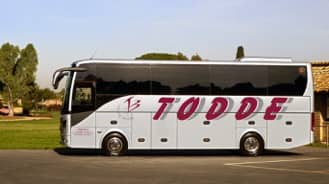
Between November and January many Italian schools choose their supplier for spring trips, and at that point the school office always faces the same questions: which documents to ask the transport company for, who has to check the driver, whether the Polizia Stradale (the traffic police) needs to be informed. The rules on coaches for school trips are not in a single text, but in a few circulars from the Ministry of Education, in the Codice della Strada (the Italian Highway Code) and in the European regulation on driving times.
Below we set out what you need to know, with the official references. We work with schools from our Rome base in Via Ugo Forti, through our coach hire in Rome.
Since September 2025 we have also been operating from our base in Lainate, with our own vehicles for bus hire in Milan and departures from Lombardy.
Rules on coaches for school trips: the texts to know
The historic reference is ministerial circular no. 291 of 14 October 1992 on guided visits and educational trips. In 2016, with note prot. no. 674 of 3 February, the Ministry sent schools a handbook prepared by the Polizia Stradale; with note no. 2059 of 14 March 2016 it then published some clarifications. The Ministry specifies that the 2016 note does not replace the 1992 circular.
One point clarified by the Ministry closely concerns teachers: the note does not give teachers and head teachers any new responsibilities. It is not up to you to establish whether the driver is fit to drive; that is the transport company’s job. The school, on the other hand, must ask the company for the documents and the checks on the condition of the vehicles. The Ministry’s page on educational trips collects the notes and the answers to the most frequently asked questions.
The documents to request from the transport company
Circular 291/1992, at point 9.8, lists the documents to obtain when the school organises the trip itself, without an agency. Some references are dated (it mentions lire and the old “KD” certificate), but the approach is still valid. In practice, ask for:
- the vehicle registration document, showing the owner, the annual roadworthiness test and its use for hire with driver;
- the authorisation to operate coach hire with driver, which is now governed by law no. 218 of 11 August 2003 and issued by regions or local authorities;
- the category D licence and the Carta di qualificazione del conducente (CQC, the professional driver qualification card) of the driver, or drivers;
- a declaration from the vehicle owner that driving and rest times have been respected in the week before departure;
- the insurance certificate, with cover for the passengers carried;
- a declaration that the vehicle has a tachograph, and certification that an authorised workshop has checked it is working properly.
Ask for everything at the quote stage, not the week before. The circular requires these documents to be attached to the resolution of the school council, so the school office needs them in good time. If you use a travel agency, the circular instead requires a declaration from the agency on the safety requirements of the vehicle (point 9.7). For school trips by coach in Rome we work out the vehicles and the programme of the outing with you.
How many hours the driver can drive on a school trip
Driving times are set by Regulation (EC) No 561/2006. The main rules: a maximum of 9 hours’ driving a day, which can be extended to 10 no more than twice a week; after 4.5 hours of driving a break of at least 45 minutes is required; daily rest is 11 hours, which can be reduced to 9 no more than three times between two weekly rest periods. On top of this come the limits of 56 hours’ driving a week and 90 hours over two consecutive weeks.
Circular 291/1992 adds a rule designed for schools: if, for exceptional reasons, the trip keeps the vehicle on the move for more than 9 hours in the day, two drivers are needed. The same circular generally prohibits travel at night. For a day trip this means building the programme around the driver’s day and the permitted driving hours, not the other way round.
Polizia Stradale checks before departure
Through the “Gite scolastiche in sicurezza” (safe school trips) initiative, the Polizia di Stato and the Ministry offer schools the chance to have the vehicle and driver checked. A few days beforehand, the head teacher sends a notification form to the Polizia Stradale section in the provincial capital of the province the trip leaves from. The police can then schedule a check at departure or spot checks along the route. The request is not compulsory: it is a service available to schools.
The check covers the documents of the vehicle and the driver and the equipment: tyres, seat belts, lights, mirrors, fire extinguishers, emergency exits. The importance of these checks is clear from the figures released by the Polizia di Stato: between 16 February and 31 December 2016, 15,546 buses and coaches were checked, 10,126 of them at the request of schools, and 2,549 had irregularities.
If you request a check, allow a margin. If the class has to leave at 08:00, the coach should be outside the school early enough for the inspection, and the students should not board until it is over.
Seat belts, behaviour on board and the teachers’ role
Article 172, paragraph 6 of the Codice della Strada states that occupants of minibuses and buses aged over three must use the seat belts fitted to the vehicle when seated. Passengers must be informed of this obligation by pictograms on the seats; the same notice can be given verbally by the driver or the group leader. On our vehicles used for schools there are seat belts on every seat. Before setting off, it is a good idea for a teacher to walk along the seats and check that they are fastened.
The handbook asks teachers to report any improper behaviour by the driver to the police, such as using a phone while driving, listening to music through earphones or drinking alcohol. For passenger numbers and choosing the vehicle, you may also find our page on how many seats a coach has useful: the count must include the teachers, and circular 291 requires at least one accompanying adult for every fifteen pupils.
On safety, Todde Bus takes part in the BuSicuri campaign run by An.bti Confcommercio (the Italian national tour bus association), and Marco Todde has spoken in the press calling for more cooperation between schools, institutions and tour bus companies. Our drivers hold a category D licence and an up-to-date CQC, and have specific training in transporting minors, in Rome as on school trips departing from Milan.
How to request a quote for a school trip by coach
For spring trips it is best to book 2-3 months ahead; in normal periods 2-3 weeks is enough. In your request, tell us the date, departure time, school address, destination, number of students and accompanying adults, planned stops and return time. With these details the written quote shows what is included (driver, fuel, passenger insurance, maintenance) and what is extra, such as tolls.
In Rome, coach hire prices are given as indicative hourly bands, useful for a first idea of the costs.
For departures from Lombardy, the cost of a coach in Milan is calculated for a full day, with indicative prices for each type of vehicle.
If you are planning a trip of several days, a school trip departing from Rome needs a programme built around the driver’s driving times as well.
Schools leaving from Lombardy have a dedicated version for the school trip from Milan, covering Venice, the ski week and European capitals.
Phone: +39 06 4882027. Email: info@toddebus.it (for trips departing from Lombardy, subject line: “Milan”).
Frequently asked questions
Is it compulsory to inform the Polizia Stradale before a school trip?
No. The Ministry and the Polizia di Stato make clear that requesting a check is optional. It is a service available to the school, which can ask for a check at departure by sending the form to the Polizia Stradale section in the provincial capital the trip leaves from.
Does the accompanying teacher have to check the driver’s licence?
No. According to the Ministry’s clarifications, checking that the driver is fit to drive is the transport company’s job. The school must ask the company for the documents on the vehicle and driver and keep them on file.
Do students have to wear seat belts on the coach?
Yes, if the vehicle has them. Article 172 of the Codice della Strada requires occupants of buses and minibuses aged over three to use the safety systems fitted when seated.
When is a second driver needed on a school trip?
Circular 291/1992 requires one when the vehicle is on the move for more than 9 hours in the day. Regulation (EC) 561/2006 sets the daily driving limit at 9 hours, which can be extended to 10 hours no more than twice a week.
Can a school trip leave at night?
Circular 291/1992 generally prohibits travel at night, with exemptions for long train journeys and some trips abroad by ship. For coach trips it is therefore best to schedule departures and returns during the day.